How to write a sex scene: Advice from Beth Miller
If we’re going to talk about how to write a sex scene, then we need to hear from the experts. I started on top at the top with author and lecturer, Beth Miller. She literally teaches a course at West Dean in England called “How to Write Sizzling Sex Scenes.”
During the interview, not only did I learn a lot from Beth, it was a fun conversation too. I had to edit out fits of giggles. We dished about:
- Why reading scenes that go wrong teaches us how to do it right
- Explicit vs implicit details based on comfort of the writer and the demands of a genre
- How showing the way a character feels is more important than what’s happening physically
- Specific questions Beth asks beta readers when getting feedback on sex scenes
Beth also shared what not to do when writing a sex scene:
- Don’t go crazy. Write sex scenes in the same style as the rest of your story
- Don’t forget to include dialogue during sex
Remember: “The best sex scene is the one that’s in the reader’s head.”
Listen to Naked Narratives on Spotify or read below!
Beth: I like the word moist.
Jen: You know what? I should have a compilation of people saying “moist.”
Hi and welcome to Naked Narratives, the writing podcast. Today we’re talking with Beth Miller. She’s a phenomenal writer, teacher, and book coach. She’s the author of six books and another one to come, including the top 20 Kindle bestseller, The Missing Letters to Mrs. Bright. When she’s not writing or providing individual book coaching, Beth is a lecturer on the creative writing and publishing MA program at West Dean College, and she hosts a variety of writing workshops. So, Beth, before we dive into all things how to write sizzling sex scenes, I thought it would be fun to ask you a few quick-fire questions. Are you ready?
Beth: I’m ready, go for it.
Jen: Alright, so when you are writing, what is one of your favourite words for the private bits? Either gender works.
Beth: Well, I was struggling to answer this question actually, because I don’t think I have a favourite one. I realize there’s not that many words for women’s parts and there’s quite a few for men, and none of them are all that appealing out of context. They might be fine in context. There’s quite a few I don’t like. But I realize this is a good question, because I realize that I often don’t refer to things by name, actually. I write my sex scenes that much more about the sensations and I expect the reader to fill in the gaps. So I don’t have a good answer to that one. Sorry.
Jen: That was actually an important answer because you’re right. We have enough words to describe lady parts and it can maybe help people think about how, if you’re uncomfortable using those words, there are other ways to write these scenes without naming them. In fact, maybe that’s not what you want to do. So that’s awesome. Thank you for that. Next question. Is there an adjective, or any word really, that you hate using or reading?
Beth: Well, obviously, you know, I love the word moist.
No, not really. I don’t mind the word moist, but for some reason moist gives loads of people the ick. I hate the word throbbing for some reason. I agree. And any big words. There’s the one that I often quote – I won’t name the author, but it’s someone who was shortlisted, I think even won the Bad Sex Award a few years ago – who used the phrase. “Bulbous salutation.” Which –
Jen: Ew.
Beth: I know. I’ve often thought maybe I should get that on a t-shirt or something. I think those are the sort of things that people say when they’re feeling a bit embarrassed about writing their sex scene. But I suppose, there’s nothing I intrinsically hate. But I can’t bear to see clichés. You know, if I see any more “rosy nipples,” I’m going to scream.
I guess clichés is probably the right answer to that one.
Jen: Cliché is a great one. I think the bad sex award is for writing, not the actual act.
Beth: Yeah. Yes, indeed. Yes, that would be very uncomfortable.
Yes, the bad sex award sadly has seemed to have stopped now. It was running every year, but the pandemic seemed to put the end to it. It took passages from published novels that had particularly egregious sex scenes and then gave an award each year. And I mean, it was terrible, really, because you’re taking it out of context. But it was also very, very funny. So a very good tool for teaching.
Jen: Yes, I want to dive into that too a little more because I’ll explain to listeners. I was in your class and we did talk about that. I found it very helpful as well as funny.
All right. Next question. When you’re finished writing a sex scene, is there anyone that you trust to give you feedback? Who do you show first?
Beth: This is a really good question because sometimes writers are really uncomfortable. They get feedback from everything but they’re uncomfortable getting feedback on their sex scenes. Conversely some people are uncomfortable giving feedback on a sex scene. I do take my sex scenes to my writing group and amid much laughing and nudging we get through those.
I suppose it’s good to find somebody who can read the sex scene in the way it’s intended. I remember with my first novel, one of my friends read the book. I said to her a little embarrassedly, what did you think about the sex scenes? And she said, “They made me want to run out and have sex with someone.” And I was like so thrilled by that.
Jen: Wow.
Beth: Yeah, job done really. So I think next time I write a really explicit scene I might go and see what she thinks about it.
Jen: She sounds like she would give you good thoughts, and if it works for her or not.
Beth: Absolutely if it worked for her.
Jen: And is there a book that first inspired you to give writing sex scenes a go?
Beth: I think for women of a certain age, quite a lot of them will have this answer. It’s Forever by Judy Blume. A grubby copy got passed around all of us at school because it is about first love and first sex. It’s beautifully done, but it’s also quite funny and sort of cute and a bit embarrassing.
In fact, Judy Blume is a great writer of sex. A book that I sometimes send people to if they want to read something with some rollicking fun sex scenes in is her novel for adults called Wifey. The sex scenes in it are just so good. They’re quite hot, but they’re also really, really fun.
When I was trying to think of an answer to this question, I suddenly remembered that I had an awkward introduction to sex scenes in books. When I was 13, I went on a summer camp. Which was absolutely ghastly. I was bullied.
Jen: No!
Beth: I don’t know why I’m laughing. It was terrible. And I took to my bed because I wanted to get out of the situation. There were a few nice older kids, and they brought me some books to read. Unfortunately their books were not suitable and one of them brought me Emmanuel. Which was… It’s soft porn really. So wide-eyed and with nothing else to do but sit in my bed and read, I read Emmanuel when I was 13. I’m sure that has influenced me in some ways though not necessarily in good ways.
Jen: You know, I’m surprised sometimes that books people read at young ages. But, better to explore in books sometimes.
Beth: Exactly.
Jen: Thank you for sharing all of those.
Maybe I should explain to listeners why I’m so excited for this conversation. I was fortunate enough to be in Beth’s classroom twice. The first time was when I attended a mini hour-long session at the London Jericho Writers Festival in 2024. Beth had a room that was like packed to the rafters. Everyone wanted to hear about how to do this. It was really cool. The room was so full of like people of diverse ages and backgrounds and everyone just wanting to think about how to put this into their book. And it was a really fun time. And then during that session, Beth mentioned she had la day-long lecture at West Dean College.
So I went down to West Dean and attended the day-long session and it just was really helpful and got me over my fear of it in some ways. And one thing I’ve noticed now, very specifically thinking of my MA that I’m working on at Birkbeck, is not a lot of students bring their sizzling scenes to the classroom for feedback. Also relatively few instructors are talking about it.
So, Beth, can you share a little bit about your journey as a writer, but also how you got into covering this topic?
Beth: I’m really glad that you enjoyed the sessions. It is really interesting. I’m going to start with the last bit first, which is I have noticed that, when I send a manuscript to my editor, a finished novel, they will often send back the edits. The manuscripts is absolutely covered in edits. You know, red pen everywhere except for the sex scenes. And I’ve been very interested in that. I think it’s very interesting that this is still kind of a bit of a taboo.
And I suppose my journey into that side of it was when I started writing my first novel. It seemed very natural to put some sex scenes in. It was about my first novel called When We Were Sisters, which was published in a long time ago now, 2014. It had sex scenes in it which felt to arise very naturally in the story. And I realized talking to new writing friends that I was making that they were either avoiding it or doing it reluctantly or felt almost like they were typing with their eyes closed. I don’t feel embarrassed by it. I’m happy to laugh and blush and make terrible double entendres with the next person, but I’m not shying away from it.
It doesn’t hurt that my background is in sexual health education. So my background is in psychology and sexual health. I used to teach HIV education. And then I widened the work I did and I started teaching sexual health in schools, including things about consent and relationships, but also about the actual mechanics of sex and contraception. I can’t really remember, but looking back, probably I was a little bit awkward at the beginning. But once you’ve sat in a room of disaffected 14 and 15-year-old boys and taught them how to put a condom on a green plastic willy, there’s nowhere to go really with your embarrassment. You’ve either got to get over it or you’ve got to get out. And… it just felt when I was writing that it was natural. I wasn’t thinking, “I’d better put a sex scene in here now to make the story interesting.”
I don’t like a gratuitous sex scene. I do go quite prim if I think someone’s put in a sex scene just because they think, “I better have some sex here.” If it’s part of the story, if it flows naturally… I hope (it sounds like it really worked for you, Jen, and I’m really pleased.) My aim with my sessions is just to help people sort of get over that threshold of embarrassment so that when they’re writing a sex scene, it just feels like another scene like any other. That’s my aim.
Jen: That’s so cool. I want to circle back to one of the things you’re talking about, which is around the difficulty of writing the scenes. It’s something I think a lot about because sometimes my friends will ask, why are you trying to put this in your book? But I find it interesting that writers have no problem writing about murder, death, betrayal, all these awful things. And yet sex is so difficult. Why do you think that is?
Beth: Yeah, I don’t know if it’s a cultural thing or if it’s universal. I can only speak from my own experience. You’re right, people who wouldn’t bulk at writing an absolutely blood-drenched scene of carnage. Then start going all shy and retiring when it comes to a sex scene. We have cultural taboos about sex. We’re embarrassed about it. I mean, I’m British and there’s a sort of a British embarrassment about it, but all cultures have their weirdness about sex stuff.
Of course we should write about sex, because one of the things we should do as writers is write about the human experience. I don’t know about you in your life, but for me, it’s a much more common experience than, say, someone holding a gun against my head. That’s not something I’ve ever experienced. [Sex] is much more part of the human common experience than some of the other things that people write about. We should write about human experiences. I think it is important to write about.
Jen: In a lot of women’s fiction, I’m using air quotes around that because anyone, however you identify, can read these books. I think, more [it’s] popular to include it. Maybe things are changing and people are starting to get more comfortable. Speaking of that and how all scenes should have a purpose, if someone is trying to decide whether or not their story needs it, do you have any kind of advice for how people can decide? How does the story necessitate this scene?
Beth: That’s a really good question. My first answer is if the person who’s writing is seeking traditional publication, then it’s really important for them to consider the genre that they’re writing in. There are unwritten expectations in various genres about whether sex scenes are included and what level of explicitness a sex scene should have. And what kind of language it uses. Regardless of publication, then it’s all down to what suits your story and your voice.
And I don’t want to encourage people to put in sex scenes if they’re wildly uncomfortable about it. If you think it’s something that the story would benefit from, will it move the story on? Will it reveal character? Will the stakes deepen if you have a sex scene? Will the story be as entertaining and meaningful without the sex scene?
All of those are considerations. I was going to say a bad sex scene is better than no sex scene. That isn’t true at all.
Jen: But maybe in terms of just trying it to see if they’re comfortable.
Beth: Exactly, that’s what I meant to say. Thank you.
Yes, I think it’s really good to try and write a sex scene and see if it feels like it flows naturally. Do you feel like, once you’ve finished it and rewritten, it that it works for the story or does the story come to a grinding halt and your reader starts to look a little bit, “Ah, this doesn’t work.” You might inadvertently written a bad sex scene.
Although bad sex scenes can be tidied up and made to be good sex scenes quite easily. It’s a good thing to try because a sex scene done well can really elevate a story into something just amazing.
Jen: I really like what you were saying about it can raise the stakes… Let’s say someone’s decided tick, tick, tick. I do need the scene. How should they think about the structure?
Beth: It isn’t any different to any other scene. When I run my workshop on writing sizzling sex scenes, I always say my goal is to put myself out of work. A sex scene is like any other scene. And in fact, even more so because it has a rise and a fall like any other scene, but also sex has a rise and a fall…
Let’s say you’re writing a scene where two people are in love and it starts with all the lingering glances and you’re gently getting into the, know, maybe they’re out to dinner and they don’t want to eat anymore. They just want to rush back to someone’s house or a hotel. The tension increases and increases… I’m describing like a rising action. Then you get back to the house and the clothes are cast off. It’s all action. And there’s a climax, literally and metaphorically, and then there’s falling action. It’s like a scene like any other. It follows the natural pattern of a scene. But in terms of scene structure, no, there’s nothing new that you need to know. You’re showing character. You’re showing what happens. You’re putting in some action, some dialogue, some interiority. It’s just the same as any other scene.
Jen: That’s really helpful. So the words we use in these scenes is so important. I love that quote you said, it’s like people are writing with their eyes closed. A lot of that is the language and how explicit should one be? Should we say these words like throbbing? So what are your thoughts on explicit? I’m going to not be able to pronounce that, but being explicit in a sense.

Beth: Is it explicitness or is it ex… well anyway… don’t know. Expliciticity. I like that word.
How explicit is totally down to the writer really. You can be explicit actually without saying very much. You can just sort of hint at things and because the marvellous thing about writing and doubly so with sex scenes is your reader will fill in the gaps.
You can be sure of that… The best sex scene is the one that’s in the reader’s head. The one that the reader is imagining.
How explicit a writer wants to be is down to, as I’ve said, the demands of the genre, but also how comfortable they are and what is necessary for the scene. I’ve read some absolutely brilliantly hot sex scenes that aren’t explicit at all, but they’re just really hinting at things. There’s lots of sensations and feelings. I like those ones very much, where you’re just imagining what’s going on and the writer’s giving some hints to keep you going. I do like an explicit sex scene, but too many of them, can feel like it’s going over the same beats. I feel like I’ve read this before.
I don’t want a writer to feel uncomfortable at the level of explicitness that they’re writing. If a writer is uncomfortable about writing a sex scene, they don’t have to be very explicit.
In fact, there’s a whole genre really of sex scenes that I’ve called, when I teach this, call implicit sex scenes. Which is where you have a sex scene, but you never really show any of it. It’s a bit like in the old films from the 40s when the couple’s faces started to go towards each other for a kiss. And then the camera lifted up and went onto a curtain or something. You can do that in writing. You can do all the buildup. You can do the longing looks and even the clothes puddled around the room. And then we can see the people afterwards. We can see them lying in bed, or smoking a cigarette, or the cat standing at the corner of room looking at them accusingly. The reader will know that sex takes place but the writer’s done that without actually writing the sex. If you’ve done it well – if you’ve done enough build up intention – the reader won’t feel shortchanged because the reader’s mind will do the work of what’s missing.
Jen: You have to give them enough information so they know what is happening. But I think there’s an element of putting a puzzle together in stories, not just about sex scenes.
Beth: That’s exactly right. I see so many first novels that have everything explained on page one because they feel like the reader won’t understand if I don’t explain this. But no. The reader loves to put the puzzles together. You’re quite right. And the reader loves the mystery. That’s what keeps the pages turning. I’ll keep reading because just a piece of the jigsaw missing that, you need to fill in.
Jen: I love that.
We’ve talked about it a little bit – I’m giggling remembering some of them. Can you tell me a bit like why do you think it’s important for all writers and your students to read some of these bad sex scenes?
Beth: I think it’s very encouraging to see that even great writers – writers who’ve won awards, writers who’ve published dozens of books – can get it so… I don’t want to say wrong, but yeah, wrong maybe in a sex scene. It gives us all hope.
I give students a sheet that’s got some excerpts from novels that have been shortlisted for the Bad Sex Awards. By the time a writer has read all those, they just said, “Well, I can have a go at this.”
These are great writers. They’ve really messed up. And it’s quite a useful tool to see what does send a sex scene off kilter.
Some of the obvious things. First of all, unless you’re writing pornography, you don’t want your sex scene to be too porny. That’s not really what your readers rocked up for. If they’re reading a novel, they want to know about character. They want to know how people are feeling. And the trouble with pornography is that it doesn’t really treat the people as people. They’re sexual beings but they don’t really have feelings. Everything’s too perfect and as human beings, sex is generally not perfect. It’s a messy, messy, noisy business. And funny. And silly. And awkward.
Pornography is not very helpful for writers who want to write a sex scene that is part of a story. Some of those sex scenes that we look at that have won the bad sex awards are a bit too porn-based or they’re a bit too male-gaze. The woman is just seen as a being an object of beauty, but we don’t get to see how she feels or what she thinks.
Then there’s lots of other things that people do wrong, and often about language. People are embarrassed, so they hide behind terrible euphemisms. Or they use very big words that just feel really different and out of kilter with the rest of the story. Or they resort to cliché.
Looking at what people do wrong and underlining what is wrong here is just a really good way of thinking about how could you do it right. It’s not actually rocket science.
You need to write your sex scene in a similar style to the way you’ve written the rest of your story. And that’s why often it goes wrong. The writer suddenly loses their minds and starts writing in a completely different way. So write in the same style.
It’s about thinking about how it really feels for the characters. What are they feeling? What are they thinking?
You can bring in other things as well. Something that’s really fun in sex scenes is your characters don’t have to be completely focused on the sex act. When people have sex, they can be thinking about other things, other people, unrelated things. If the sex is boring, they might be thinking about what they’re going to have for dinner. Or if the sex is really exciting, they might be thinking about all sorts of other things.
And people talk during sex, so you can bring in dialogue. I do very often. Sex scenes that win the bad sex awards either don’t have any dialogue –which makes them feel very sort of odd and a bit pornographic – or the dialogues really weird and stilted and doesn’t fit the character.
Jen: All right. Speaking of feedback, there is something kind of especially cringe. I feel like I have to warn people if it’s got a sex scene. How can writers go about getting feedback specifically on this?
Beth: Let’s assume that you’ve got someone, a writing group or you’re in a class, or you’ve got a writing friend who gives you feedback.
A really good way of getting feedback from a sex scene is to ask a few questions. Otherwise, you can end up with feedback that’s either too specific – this comma’s in the wrong place, which you don’t really need. Or it’s too general like, “Oh I liked it.”That’s not very helpful.
One of the questions that’s really useful to ask of your sex scene is, “what did it make you feel?” Because sometimes you write a sex scene and you want t it to be really sexy. You want your readers to have to rush off and put their face in the fridge to cool down after reading it. But in fact, your reader says, “Oh, I just felt uncomfortable” or “It was funny.”
This happens to me a lot. I say, “Was that sex scene really hot?” My readers are like, “No, was it meant to be hot? I thought it was really hilarious.”
And then I suppose another question for the sex scene is, was there enough of it or did it go too quickly?
Often another thing that writers tend to do is rush, rush, rush. They want it over. They’re writing with their eyes closed or they’re a bit embarrassed and they’re like, god, alright. It’s gonna be all really quick and let’s just… five seconds later. Now that might be realistic, but only if it’s meant to be really quick and slightly unsatisfying. But is there enough of it? Or does it go on too long? God knows there’s also a possibility.
Jen: Was it good for you?
Beth: Asking questions of the people that you want feedback from is really helpful. In terms of who to ask, aunties can be helpful. I think sometimes one of the reasons why people feel terribly awkward about putting a sex scene in their novel is because they’re thinking ahead to their mum, or their aunt, or their dentist, or whoever reading it. And sure, I agree. That can be an embarrassing thought.
But like that saying, dance like no one’s watching. You have to write your sex scene like no one’s going to read it. And in fact, I have put some quite explicit sex scenes in my book and I’ve not felt embarrassed. In fact, a few people said really nice things about them.
One of the nicest things that one of my readers said about my third novel, The Two Hearts of Eliza Bloom, was “God, that sex scene in the woods was the most feminist sex scene I’ve ever read!” I just so thrilled by that. It was about a woman who was very unconfident but she took charge.
So, if you’re writing it thinking my grandma’s gonna read this, then you are going to feel probably a bit inhibited but in fact you’ll find… But once people are reading your book, they’ll just fall into the world of your book. They’ll be captured by the spell of the story. And they won’t even remember that you’ve written it. I don’t know if you’ve ever read a book that someone you know has written, but after the first few chapters, you forget who’s written it and you’ve just fallen into the story. That is really likely to happen. You have to try and write it as no one’s going to read it because otherwise you’re just going to start censoring yourself and that’s not going to help. With it just feeling natural.
Jen: Don’t censor yourself and then ask those specific questions. Maybe more specific than was it good for you. But I think those are really good examples.
Beth, thank you so much for all of the amazing advice and suggestions so we can continue writing sex scenes and moving forward as writers.
What are you working on next and what would you like listeners to know about?
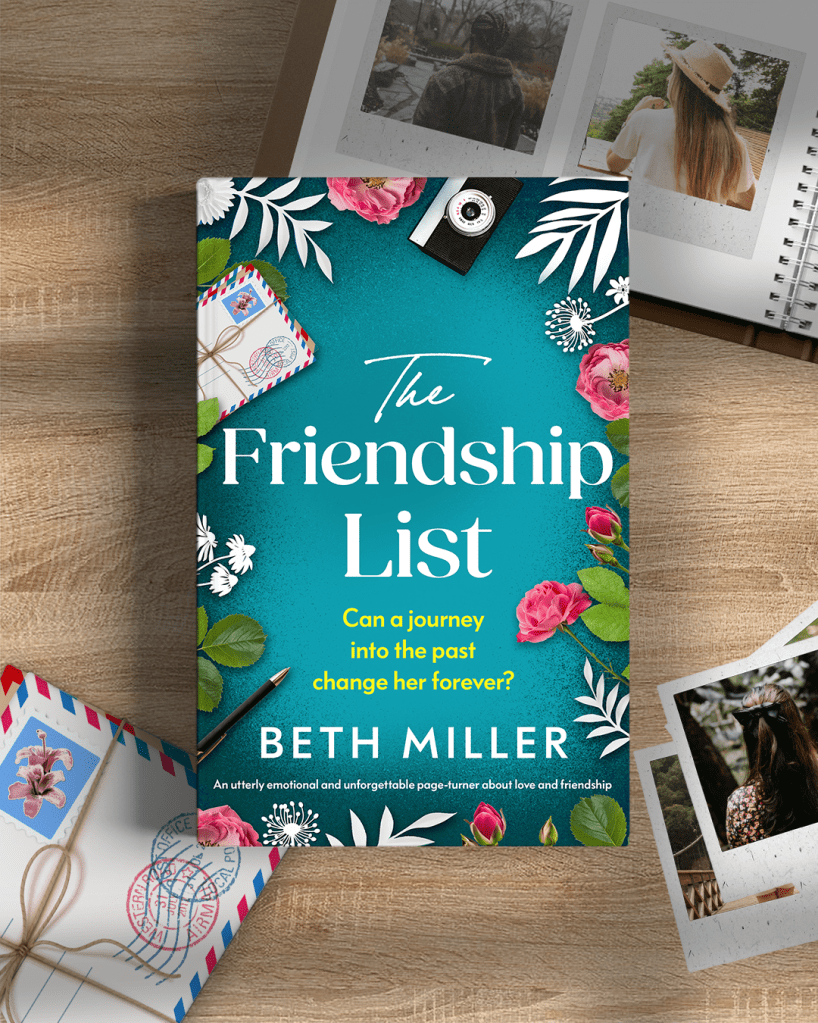
Beth: Thanks, Jen. My next novel – my seventh novel –l is coming out on the 18th of August. So if you’re listening to this podcast after that, it’s already out. It’s called The Friendship List. It’s published by Bookouture and it’s available on Kindle and in a paperback and audiobook, wherever you get your books.
Jen: Can’t wait to read it. I also read The Missing letters to Mrs. Bright, by the way. Beth teased out a threesome in that book.
Beth: Yes it does. Mean, in fact, one of my one-star reviews mentions the threesome and how disgusting it is. So if that doesn’t make you want to read it, I don’t know what will.
Jen: Gosh, that’s actually really good. What don’t be afraid of the one star reviews. They can make you want to read more. Thank you so much, Beth.
Beth: Exactly!
Jen: And thank you everyone for listening. I’m Jen Bunting, your host and a master’s student in the creative writing program at Birkbeck University of London. I hope today’s conversation with Beth inspires you to write.
So before we wrap up, here’s a quick writing prompt. Set a timer for just five or 10 minutes and write the worst possible sex scene that you can. The more awkward, the better. Try to use words like moist, throbbing, even bulbous salutations, which I can’t even say with a straight face. Remember, no one needs to see this. It’s just for you. It’s just for fun. Just to break the ice on the page.
If you try it, let me know. You can find me at Naked Narratives on Instagram, Blue Sky and TikTok. And of course here as well.
I hope to see you in the next episode.
Learn more about Beth Miller on her website https://www.bethmiller.co.uk/ and don’t forget to read her latest book, The Friendship List.
 Naked Narratives Writing Podcast